
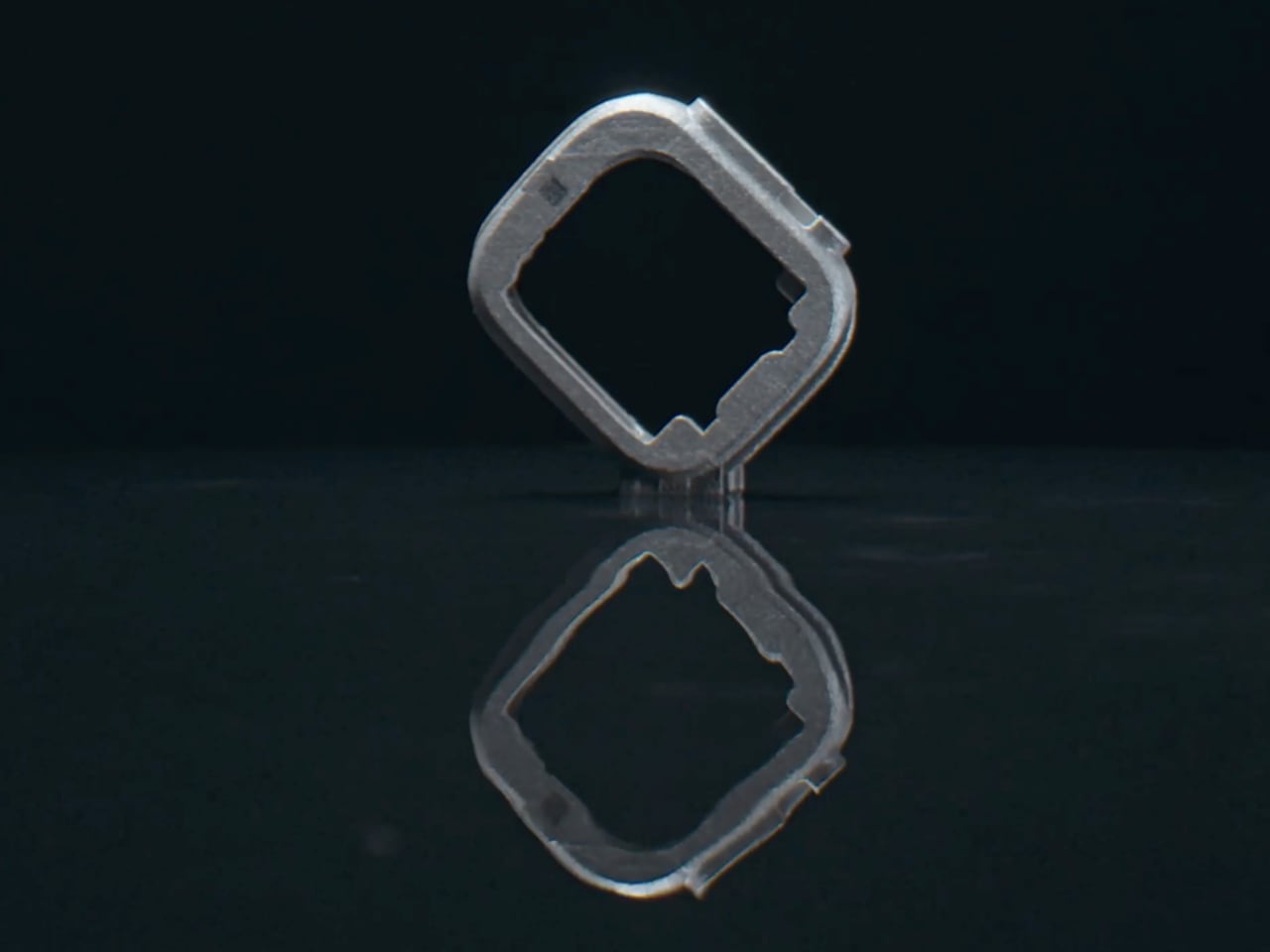
For the first time in industrial design and engineering, Apple has developed and proven additive manufacturing can use high quality and 100% recycled materials to mass produce industry-leading products, both with zero compromises on the existing design and even improvements on the functionality for those industrial designs.
400 metric tons of raw titanium is saved each year by doing this, simply by doing the Apple (and Steve Jobs) thing to do; question why something must be the way it has been done previously?
You can read more about this advancement

 www.hodinkee.com
 www.yankodesign.com
While the cases appear identical from the outside, Bergeron notes that the new 3D-printed construction incorporates structural features unattainable with traditional CNC machining.
"As you can imagine, you are somewhat limited by whatever manufacturing technology you choose," Kate Bergeron tells me, "and we're able to mold our antenna windows and create our water sealing by adding some additional features into the metal that we actually weren't able to do machining-wise."
Bergeron then tells me that product development at Apple is like an extreme team sport, and when the ball leaves one team's court, the other teams come together to figure it out. Designers, engineers, and material scientists must work closely with manufacturing and operations, as well as other teams, to crack the proverbial nut. And eventually, they did."
"I feel like we might be underselling the fact that this is half the material, which is a tremendous unlock," Chandler explains to me. "Normally, I get really excited about 5% material efficiency improvement. So this is a big deal. Even once you unlock 3D printing, the belief was that you couldn't do it with recycled titanium powder. But why?"
"We’re extraordinarily committed to systems change,” Sarah Chandler, Apple’s vice president of Environment and Supply Chain Innovation, states. “We’re never doing something just to do it once: we’re doing it so it becomes the way the whole system then works.”
400 metric tons of raw titanium is saved each year by doing this, simply by doing the Apple (and Steve Jobs) thing to do; question why something must be the way it has been done previously?
You can read more about this advancement
In-Depth: The Engineering Behind Apple's 3D-Printed Watch Cases
A close look at cutting-edge casemaking at a massive scale.
www.hodinkee.com
Apple’s 3D-Printed Titanium Apple Watch: When Manufacturing Becomes Design Philosophy - Yanko Design
Apple's shift to 3D-printed titanium marks a turning point, not just for wearables, but for how material innovation becomes the foundation for meaningful design change. Every Apple Watch Ultra 3 and titanium Series 11 case now emerges from additive manufacturing using 100 percent recycled...
www.yankodesign.com