Supreme Court rejects Sony’s attempt to kick music pirates off the Internet

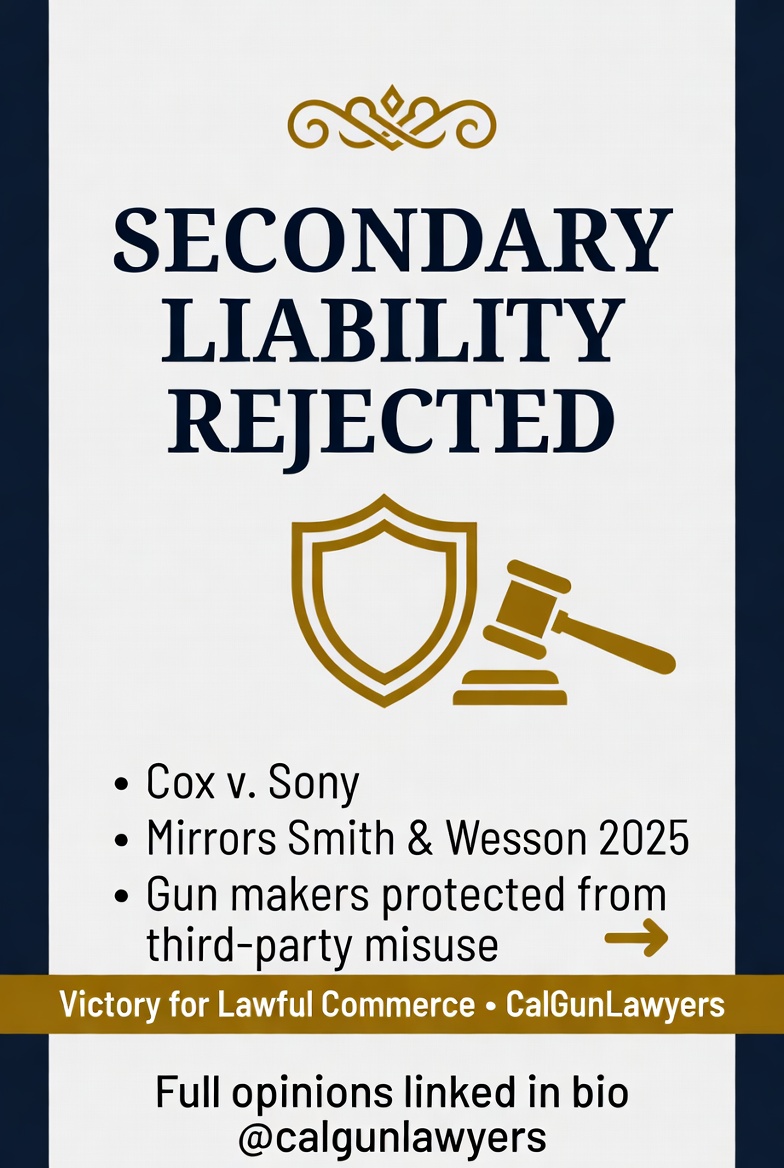
Just an FYI, the gun lobby is already saying this ruling will bolster the cases of legal gun manufacturers and sellers being sued by cities over the use of their legal product.
 
Just an FYI, the gun lobby is already saying this ruling will bolster the cases of legal gun manufacturers and sellers being sued by cities over the use of their legal product.
They can say what they want, but the legal principles in this case involve well-understood copyright law and statutes, and have nothing to do with guns. SCOTUS didn’t say “you can’t sue Cox because there is some generalized principle that says that you aren’t responsible for something as long as there is a legal use for it.”. SCOTUS relied entirely on principles of copyright law to reach its conclusion; in intellectual property law, to be responsible for someone else’s infringement you have to “induce” it, and inducement generally requires *intent* and not mere knowledge. The issue for SCOTUS is that while, under patent law (35 USC 271(b)), inducement is expressly provided for, under copyright law, inducement is a common law principle (dating back a very long time) that is not expressly dealt with under 17 USC 501. Since it’s common law, there was some fuzziness as to what degree inducement (in copyright law) requires more than mere knowledge of infringement or knowledge plus economic benefit. In patent law it’s clear that to induce you have to have an intent that someone else infringe, and that’s how it was treated in copyright law, too. All this case really does is confirm that.
 
Read the link my buddy who posted this in our group chat.

There were two main points. First Justice Thomas noted that simply providing a product is not a basis for liability, which strengthens defenses under the PLCAA.

Second is that there was no evidence that Cox promoted illegal activity of the use of its products.

So yes, the actual case was about copywriters, but tge legal principals can be used to strengthen other cases.

Here is a different article. Yes it is by gun lawyers, but it is along the lines of what the industry is thinking.

 
Read the link my buddy who posted this in our group chat.

There were two main points. First Justice Thomas noted that simply providing a product is not a basis for liability, which strengthens defenses under the PLCAA.

Second is that there was no evidence that Cox promoted illegal activity of the use of its products.

So yes, the actual case was about copywriters, but tge legal principals can be used to strengthen other cases.

Here is a different article. Yes it is by gun lawyers, but it is along the lines of what the industry is thinking.

This is entirely dumb. The issue was a rejection of the fourth circuit’s “knowledge is enough for inducement” decision. This is ONLY an issue in copyright infringement, and has nothing to do with “aiding and abetting” law in the gun context. The theory looks like it was written by a second year law student.
 
Back
Top