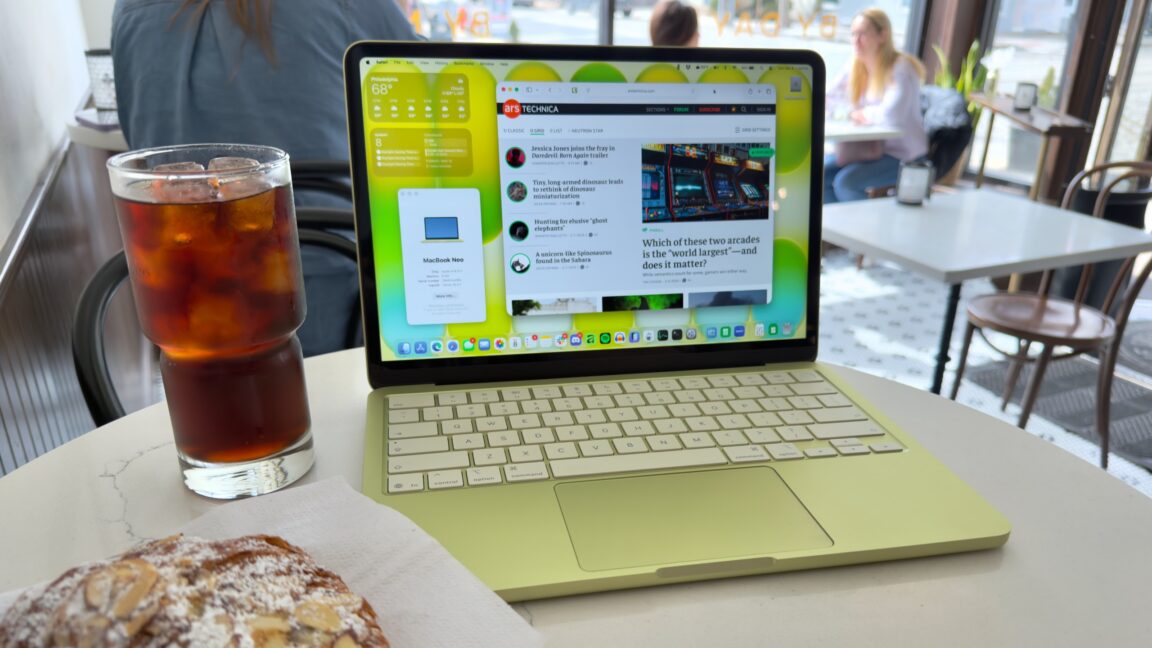
I only skimmed it, but this looks like a pretty honest review of the MacBook Neo. As expected, the biggest problem is the 8 GB of RAM.
8GB of RAM is a bummer, but this $599 laptop cuts most of the right corners.

arstechnica.com
Sure, it has 8 GB of unified memory, but I've seen it:
1) edit 3 streams of 4K in Final Cut flawlessly; 2) compile Xcode WebKit projects in 22 minutes vs 12 minutes for the Air; 3) render videos in 14 minutes vs 9 minutes for the Air; 3) and based on the iPad mini, I suspect this will be able to handle at least 25 tracks in Logic Pro.
I've also seen it handle games quite well, especially mainstream ones.
All data is from what I've read and watched from articles and YouTube
Pretty much every reviewer thinks it's a knock out of the park, and ASUS had an earnings call today where they basically shit their pants when asked about it.
This is a revolution. Yes, it has trade offs -- all products do. But you can now learn and develop apps, not just in general but iOS apps or any app for any Apple product, all in one notebook; you can learn and develop music using professional grade software; you can learn and edit photos and videos, not just 720p iMovies, but 4K professional rendered short and long videos; you can learn, read, write, and video chat with friends with ease; and you're doing so in a notebook that isn't an afterthought but the entire thought --
All at $599 or $499 for education.
I've seen a video, probably unauthorized, from a YouTuber that showed him taking the metal backplate off, and this is NOT a cheap laptop to make. This is a intentional, fully cared for design that is neat, well-made, and beautiful even on the inside. Even the trackpad mechanism is completely custom and new, and it enables something no other trackpad in its class -- or even most notebooks of any type or price -- has: a uniform, consistent clicking mechanism across the entire surface. And it's glass.
I've seen a review comparing it against a Windows laptop and a Chromebook, and the speakers completely blew it the fuck away. It wasn't even close.
We wait for even more testing, but this is not only shaping up to be the greatest low cost notebook in the industry, but one of the best notebooks period. The trackpad, SoC, display, keyboard, battery life, camera and microphone, and the OS and built in apps are just better than 90% of notebooks.
Apple is about the democratization of powerful and advanced technology, to make something so easy to use and so simple, so inevitable in its design, but at the same time can be afforded by the mass public. This is Apple pure and simple.