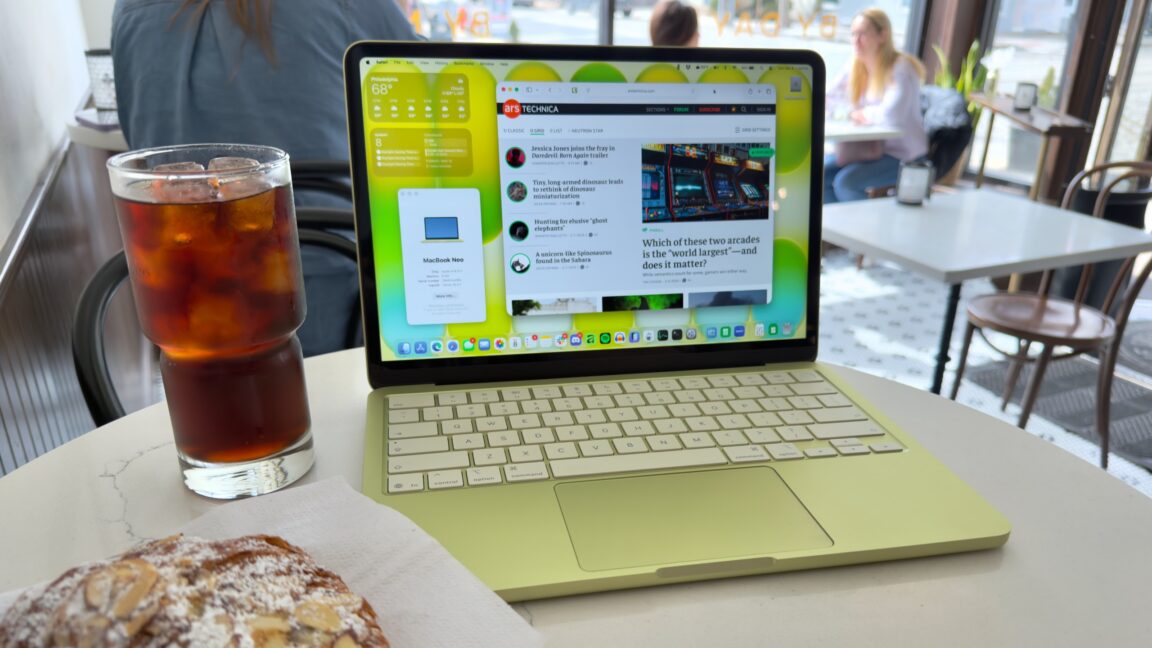
MacBook Neo is the Chosen One

Is there any way of knowing for sure once we see the logic board? Or are there multiple options that will be unclear still what they did, and will require looking closer than a simple photo of the logic board?

I wouldn't know. Maybe an expert will be able to judge it? I can imagine it depends on whether the components are clearly marked and identifiable. By the way, it is also entirely possible that the chip contains an additional USB 2.0 controller or that it is routed differently. Earlier models used to connect the keyboard etc. though a separate internal USB port for example, but I don't think this is the case anymore.
 
I wouldn't know. Maybe an expert will be able to judge it? I can imagine it depends on whether the components are clearly marked and identifiable. By the way, it is also entirely possible that the chip contains an additional USB 2.0 controller or that it is routed differently. Earlier models used to connect the keyboard etc. though a separate internal USB port for example, but I don't think this is the case anymore.
Doesn't Apple use a proprietary internal connection system called apple fabric? and not standard PCIe? They do have support for PCIe NVMe right for iPhone, but it's not a standard bus, so they don't expose PCIe busses directly to the rest of the logic board especially on A chips? Does this change the likelihood of being able to easily add a USB controller chip for the port and connect to a standard traditional PCIe bus?
 
I wouldn't know. Maybe an expert will be able to judge it? I can imagine it depends on whether the components are clearly marked and identifiable. By the way, it is also entirely possible that the chip contains an additional USB 2.0 controller or that it is routed differently. Earlier models used to connect the keyboard etc. though a separate internal USB port for example, but I don't think this is the case anymore.
Apple has been using SPI for internal keyboards (and the trackpad too I think?) for some time. When you control the silicon on both ends, don't need to send the signals long distance or through external connectors, and want to save power and eliminate some components, it can make a lot of sense to switch from a relatively complex and heavyweight bus design like USB to something bone simple like SPI.

(Here's how simple: SPI consists of just four signals, serial data in, serial data out, chip select, and clock. If you don't already know how SPI works, you can probably make a reasonable guess just from knowing that pinout.)

Why would Apple do this? Well, there's something annoying about USB which might not be obvious to most. USB1 (and USB2 because it inherits a lot of things from 1.x) was designed back in the 3.3V logic era, and thus uses a 0V to 3.3V signal swing. This is caveman stuff today. In fact it's kinda impossible, if you're in any halfway modern high performance logic process node. None of them can do 3.3V IO or power rails.

So, whenever a modern SOC needs a USB1/2 port, it has to have a little outside helper chip to act as a fancy kind of voltage level converter. (I think it's more complicated than that, because USB, but logically that's what it's doing.)

By substituting SPI for USB, Apple can cut out the middleman silicon. SPI started out at 5V iirc, but there's not really formal specs for it (it's one of those ad hoc standards), so nobody cares if you make a SPI link which uses 1.0V CMOS signal levels, or whatever.
 
Apple has been using SPI for internal keyboards (and the trackpad too I think?) for some time. When you control the silicon on both ends, don't need to send the signals long distance or through external connectors, and want to save power and eliminate some components, it can make a lot of sense to switch from a relatively complex and heavyweight bus design like USB to something bone simple like SPI.

(Here's how simple: SPI consists of just four signals, serial data in, serial data out, chip select, and clock. If you don't already know how SPI works, you can probably make a reasonable guess just from knowing that pinout.)

Why would Apple do this? Well, there's something annoying about USB which might not be obvious to most. USB1 (and USB2 because it inherits a lot of things from 1.x) was designed back in the 3.3V logic era, and thus uses a 0V to 3.3V signal swing. This is caveman stuff today. In fact it's kinda impossible, if you're in any halfway modern high performance logic process node. None of them can do 3.3V IO or power rails.

So, whenever a modern SOC needs a USB1/2 port, it has to have a little outside helper chip to act as a fancy kind of voltage level converter. (I think it's more complicated than that, because USB, but logically that's what it's doing.)

By substituting SPI for USB, Apple can cut out the middleman silicon. SPI started out at 5V iirc, but there's not really formal specs for it (it's one of those ad hoc standards), so nobody cares if you make a SPI link which uses 1.0V CMOS signal levels, or whatever.
So what do you think this means for my question?
 
No idea until we see what they actually did, but my guess is that if you use both ports, the USB 2 steals bandwidth from the USB 3, and it’s a pretty simple hack.
What should I look for when the internal tear down videos happen? Is there anything that would show something simple vs more complex, or is that hidden away even if it seems simple?
 
What should I look for when the internal tear down videos happen? Is there anything that would show something simple vs more complex, or is that hidden away even if it seems simple?
If we see a discrete usb controller, that would be a giveaway. But what i’d be looking for is whatever is between each USB port and the A18 pro.
 
I only skimmed it, but this looks like a pretty honest review of the MacBook Neo. As expected, the biggest problem is the 8 GB of RAM.

Sure, it has 8 GB of unified memory, but I've seen it:
1) edit 3 streams of 4K in Final Cut flawlessly; 2) compile Xcode WebKit projects in 22 minutes vs 12 minutes for the Air; 3) render videos in 14 minutes vs 9 minutes for the Air; 3) and based on the iPad mini, I suspect this will be able to handle at least 25 tracks in Logic Pro.
I've also seen it handle games quite well, especially mainstream ones.

All data is from what I've read and watched from articles and YouTube

Pretty much every reviewer thinks it's a knock out of the park, and ASUS had an earnings call today where they basically shit their pants when asked about it.

This is a revolution. Yes, it has trade offs -- all products do. But you can now learn and develop apps, not just in general but iOS apps or any app for any Apple product, all in one notebook; you can learn and develop music using professional grade software; you can learn and edit photos and videos, not just 720p iMovies, but 4K professional rendered short and long videos; you can learn, read, write, and video chat with friends with ease; and you're doing so in a notebook that isn't an afterthought but the entire thought --
All at $599 or $499 for education.

I've seen a video, probably unauthorized, from a YouTuber that showed him taking the metal backplate off, and this is NOT a cheap laptop to make. This is a intentional, fully cared for design that is neat, well-made, and beautiful even on the inside. Even the trackpad mechanism is completely custom and new, and it enables something no other trackpad in its class -- or even most notebooks of any type or price -- has: a uniform, consistent clicking mechanism across the entire surface. And it's glass.

I've seen a review comparing it against a Windows laptop and a Chromebook, and the speakers completely blew it the fuck away. It wasn't even close.

We wait for even more testing, but this is not only shaping up to be the greatest low cost notebook in the industry, but one of the best notebooks period. The trackpad, SoC, display, keyboard, battery life, camera and microphone, and the OS and built in apps are just better than 90% of notebooks.

Apple is about the democratization of powerful and advanced technology, to make something so easy to use and so simple, so inevitable in its design, but at the same time can be afforded by the mass public. This is Apple pure and simple.

 
Last edited:
Back
Top