Panther Lake-H Analysis CPU and GPU

dada_dave

Elite Member
Joined
Oct 25, 2022
Posts
3,946
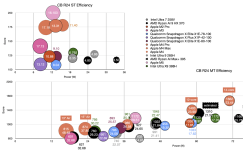
Starting with the CPU. As always, this data comes from NotebookCheck's efficiency based on CB R24 where I subtract out idle power from the devices to try to get at package power:

Screenshot 2026-02-01 at 3.51.31 PM.png
(expand thumbnail for full chart)

The reported remit of Panther Lake-H was to combine Lunar Lake and Arrow Lake-H into a single design. And largely Intel seems to have succeeded in doing that. In the link above there was a more efficient Lunar Lake ST result than pictured above, but the original Lunar Lake analysis point and most of the other data points for Lunar Lake are around what I graphed. So Panther Lake appears to have gained the ST efficiency of Lunar Lake without needing to use on-package memory* while sporting a much larger CPU die. It is also now both more performant and more efficient in ST than AMD's Strix Point HX 370.

For MT results, it's interesting. Notebookcheck measured Panther Lake at various TDPs and also measured wall power. They then compared it to various competitors including Arrow Lake and Strix Point and concluded that Panther Lake catches up to AMD and is much superior to Arrow Lake.

*which was too costly for Intel to continue using, they had to sell the memory at-cost to OEMs who are used to buying memory in bulk cheaper than Intel was getting it and didn't want to pay Intel even more on top of that to give Intel any profits.

Screenshot 2026-02-01 at 3.36.35 PM.png


Sadly, while they also measured performance at various TDPs for Arrow Lake, they only reported wall power for a single TDP (plus another Arrow Lake laptop with lower performance/power that I think was not representative on the the general efficiency curve). However, even this singular data point gives one pause to Notebookcheck's conclusions. Notebookcheck reports the following 45W TDP results for the 338H (1,136) and 285H (977). If we look at the original Arrow Lake chart (also pictured in the bubble graph above), we see a similar Arrow Lake result of 991 points using 51.9 Watts at wall power (not excluding idle). The closest Panther Lake data point on the energy graph to the TDP chart, 1,139, meanwhile uses 66.2W at the wall! From the energy graph, the Panther Lake result that actually corresponds to the same amount of actual energy usage by the Arrow Lake device (i.e. near the 51.9W result) only scored 1045 (basically the TDP value of 35W in the chart above rather than the 45W TDP). So the Panther Lake device used as much energy at its 35W TDP setting as the Arrow Lake device did at its 45W TDP setting. Now 991 (Arrow Lake) to 1045 (Panther Lake) at the same energy is still an improvement! But by nowhere near as much as simply going by TDPs would suggest - it's a difference of MT efficiency of 16% (1136 vs 977 at 45W TDP) vs 5% (1045 vs 991 at 51.9W (-idle) energy). Thus, it seems Panther Lake's MT improvement over Arrow Lake is actually only minimal here. To be fair, Notebookcheck's conclusions for AMD vs Panther Lake largely hold up as we see pretty equivalent performance and energy usage between Strix Point* and Panther Lake up until 60-80W where Panther Lake is able to achieve the same performance as Strix Point at lower energy. This may reflect the difference in fabrication node between Strix Point (TSMC N4) and Panther Lake (Intel 18A).

Panther Lake-H in some ways also has a more similar CPU cluster structure to Strix Point than Arrow Lake-H. In Arrow Lake-H, Intel used a 6/8/2 configuration where the two E-cores on the low power island didn't partake in heavy MT tasks and were reserved only for background duties. Meanwhile Panther Lake-H uses a 4/8/4 configuration where the LP E-cores DO participate in MT tasks. Strix Point uses a 4/8 setup with SMT2.

I'll expand on more concluding thoughts in a later post. On to the GPU!

*The newer Gorgon Point is represented by the Ryzen AI 9 465 above but I didn't include it as it wasn't a 470 but a smaller part (the 465), Gorgon Point is architecturally effectively the same as Strix Point (and made on the same node), and also at the time of writing Notebookcheck hasn't published the review with the idle power of the Gorgon Point device.
 
Last edited:

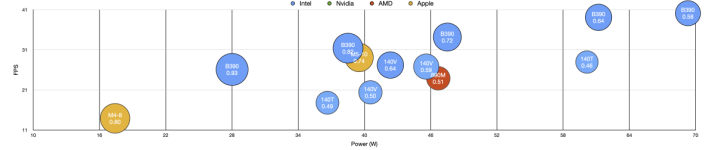
Since I was mostly interested in Mac performance and efficiency figures, I didn't publish anything on the GPU as, until recently, the benchmarks NotebookCheck used, The Witcher 3 and Cyberpunk 2077, weren't native. Now with the native release of CP 2077, I can now start doing GPU analysis! Again, this is Cyberpunk 2077 performance data from NBC with idle power subtracted out (oh and I didn't use any Qualcomm data as CP 2077 is still not native for Windows-on-Arm):


Screenshot 2026-02-01 at 4.30.29 PM.png
(expand thumbnail to see bigger chart) This is running the benchmark at raster only, no RT, 1080p Ultra. I did include Nvidia data on the larger chart, but as all their devices used more than 70W the area around 40W became too scrunched to see anything, so this is an expanded graph of the lower energy GPUs that are more relevant for this comparison anyway.

Bottom line, the new B390 GPU represents an improvement over the Lunar Lake and Arrow Lake iGPUs as well as Strix Point's 890M and is even slightly better than the M5. Of course, the B390 is a bigger GPU than all the rest*. One of the big improvements Intel made was to increase the core count from 10 to 12 cores and over 1500 compute units. This alone helps improve performance and efficiency as typically power goes up linearly with core count but exponentially with frequency. The M5 meanwhile has 10 cores and over 1200 compute units but has double throughput on FP16 tasks when relevant.

Whereas for the CPU, Panther Lake was only catching up to Strix Point in MT (offering a slight improvement over Strix Point in fact with a much larger improvement for ST of course), the GPU performance and efficiency is one area where it is a much bigger improvement over its AMD rival (and Gorgon Point will probably do little to change this). This difference gets bigger for RT and upscaling as the 890M is an older RDNA 3.5 design which doesn't really fare all that well on either task.

*the 890M is an odd duck. ChipsandCheese mentions it is an 8-core GPU, but with double the number of potential compute units per core than is typical and the potential for >10 TFLOPS of FMA throughput using its dual-issue design. Meanwhile techpowerup lists it as a 5 TFLOPS design and frankly it behaves more like the latter (and barely at that). I don't see much additional graphics performance from these extra compute units in practice.
 
Last edited:
Comparing x86 products (and Windows in general) to Apple Silicon is a bit tricky. They exist as different products meant for different purposes with different business models. Panther Lake-H, like Strix Point, is meant to cover a huge range of possible devices from thin and lights and handhelds to 80W TDP laptops. Apple's base M5 meanwhile are only meant for the lower range of that spectrum. Further, Intel and AMD offer many more variants of their respective offerings. Intel even has a non-H Panther Lake that is identical in CPU structure to the old Lunar Lake (4 P-cores and 4 LP-E cores) but without Lunar Lake's iGPU while AMD similarly offers Kraken Lake. Thus which of the various offerings are meant to compete against Apple's base M5 is not always an easy thing to suss out.

Examining the above charts, with regards to the CPU, Apple's base M5 has little trouble here. It’s so far ahead in ST, both in efficiency and performance there’s little to say. For MT, at the same power, it's over 20% faster and to close that gap, Intel takes an additional >60% more watts - by which point Apple is firmly in its Mx Pro territory in terms of power. And Apple does this with a much smaller CPU.

For the GPU, things tilt a little more in favor of Intel’s B390 where the greater number of cores helps the Intel GPU with performance and efficiency. Also, the CPU can still matter in 1080p gaming and graphics benchmarks and so one does have to caveat that the Intel graphics is doing quite well here given that the Mac's CPU is much more efficient than its Intel counterpart. While CP2077 is a better showcase for Intel than some of the others, it’s by no means Intel’s most favorable benchmark, clearly TW Pharaoh, and the performance ratio relative to the M5 in CP2077 corresponds well to the expectation set by Steel Nomad:

*
Screenshot 2026-02-01 at 9.35.11 PM.png


However, when Apple does release the M5 Pro, one expects it to vastly outperform Panther Lake-H at the same power in both CPU and GPU. One could argue the Pro’s true competition is then Panther Lake-HX (also unreleased) and discrete Nvidia GPUs (not pictured) though those will use even more power (and then there's the M5 Max). Price is a different matter and price can vary wildly in the PC space depending on the all the other details of the device in question. And certainly some Panther Lake-H offerings will be at similar price points as (binned? full?) M5 Pros even if others will be at the same price as devices with base M5s.

AMD's Strix Point (and likely Gorgon Point) maintain their position in MT CPU performance and efficiency relative to Panther Lake, but falls behind in the GPU as Panther Lake simply out muscles it. Oddly the AMD GPU does so poorly in Steel Nomad 4K relative to actual gaming benchmarks. Not sure why. In terms of ST CPU performance/efficiency AMD is also struggling here - an old design on an old node isn't helping in ST even if in MT it's still keeping up.

As stated in the OP, Panther Lake-H's remit was to combine Lunar Lake and Arrow Lake into a singular design and while Intel still maintains a huge variety of different CPU variations some of which combine different features of each, they did it. Of course Panther Lake is much bigger than Lunar Lake in every conceivable dimension, but it also doesn't come with the expensive on-package memory and more of it manufactured in house, so it isn't clear how Intel will be able to position it in smaller and cheaper devices.

However, while the top of the line Panther Lake-H represents the best of both Arrow Lake and Lunar Lake, the CPU isn't a huge performance/efficiency improvement on either - at least in CB R24, especially when the true power draw is taken into account rather than just TDP values. And it isn't clear how much the GPU improvements over Lunar Lake are driven by improvements in the cores or by the increase in cores (still a valid way to improve performance, especially in GPUs! - you know up to a point). Whether this points to Intel's 18A being more similar to TSMC's N3 node in practice than the naming convention would suggest or the core designs not representing as big an uplift or both is unclear. That said, perhaps representing the best of both is itself an improvement worth commending and indeed many reviewers are praising Panther Lake where Arrow Lake and Lunar Lake were met with slightly cooler receptions. This may also be due to the fact that AMD's Gorgon Point isn't really a new processor so by contrast AMD have stood still while Arrow Lake and Lunar Lake had to compete against the then new Strix Point.

*This chart really does highlight my oft repeated refrain with my CPU benchmark posts, we're only looking at one benchmark with these analyses. For the GPU that's also very, very true. CP2077 will have a very different performance and efficiency profile than Baldur's Gate 3 or Assassins Creed and never mind ray tracing heavy workloads like Blender. Sadly large databases of power analyses for different benchmarks are hard enough to come by since most reviewers just don't do that. But as always one should be careful about extrapolating these results to all possible CPU and GPU workloads.
 
Last edited:
Review on Ars Technica:

AMD has argued that the Panther Lake chips should be compared not to the regular Ryzen AI Max 300 and 400-series CPUs (codenamed Strix Point and Gorgon Point, and both based on essentially identical silicon) but to the larger and more powerful Ryzen AI Max+ chipsand their Radeon RX 8060S and 8050S GPUs (codenamed Strix Halo).

The only Strix Halo system we currently have on hand is a Framework Desktop, which has higher power limits and more cooling capacity than most laptops—we’ve included some numbers in our gaming benchmarks, but we mostly left it out of the CPU charts because it wouldn’t be a fair comparison. (AMD tried to send us a Ryzen AI Max+ equipped laptop to test, but as of this writing, it’s still hung up in FedEx’s network somewhere thanks to the winter storm that dumped snow all over the eastern United States last weekend.)

I see AMD trying it on for size here. While as I wrote the B390 is indeed a bigger GPU than the 890M, it’s only 50% bigger - it’s 12x128 FP units vs 16x64 for the 890M (though again chips and cheese say the structure is 8x2x128, but in practice I don’t see it). In contrast, the 8050S or 8060S are 2-2.5x the size of the 890M. And Panther Lake-H is meant to cover effectively the same range of devices/TDPs as Strix/Gorgon Point.

That said, I do think Ars' Strix Point device was a lower power unit as I've seen HX370's score much higher than that on those same (CPU) benchmarks and they even note in the piece that the power levels of the Panther Lake device were considerably higher than the other devices tested - but that also when that was accounted for (in Handbrake) that Intel was still ahead. As aforementioned, the CB 2024 results above are a singular benchmark and it is more than possible that the Intel chip pulls farther ahead of Strix Point in other CPU benchmarks (and depending on where on the power curve you are Intel can still be ahead).
 
Last edited:
And it isn't clear how much the GPU improvements over Lunar Lake are driven by improvements in the cores or by the increase in cores (still a valid way to improve performance, especially in GPUs! - you know up to a point).
So according to this:


the increase in raster performance is indeed mostly driven by GPU core count increases - though the improvement in mesh rendering will help if the game implements it (which I'm not sure if CP 2077 does) and there are a couple of other features which might help (and the ray tracing cores got an uplift but that's not really relevant for this benchmark)

One of the big improvements Intel made was to increase the core count from 10 to 12 cores and over 1500 compute units.
Sorry this is wrong they went from 8 cores in the 140V (and 140T) to 12 cores. 10 cores is the M5. Apologies for the typo
 
Last edited:
Am I reading this right: they had to use a more advanced process technology than TSMC to offset the inefficiency of moving memory off the chip, only to end up with the same efficiency as the previous generation? And they moved off chip because they couldn't earn profit off of it, because it was too expensive with doing on chip? Is that correct? Lmao?

Hartley? Paging Hartley. Where is he? Well, we can't blame him for mixing stuff up about who is cost cutting and who is innovating. After all, the work of a MacRumors columnist is so challenging.
 
Am I reading this right: they had to use a more advanced process technology than TSMC to offset the inefficiency of moving memory off the chip, only to end up with the same efficiency as the previous generation? And they moved off chip because they couldn't earn profit off of it, because it was too expensive with doing on chip? Is that correct? Lmao?

Hartley? Paging Hartley. Where is he? Well, we can't blame him for mixing stuff up about who is cost cutting and who is innovating. After all, the work of a MacRumors columnist is so challenging.
Effectively, yes. Though Arrow Lake and Panther Lake are also much bigger SOCs than Lunar Lake (so bigger, faster more power hungry memory buses and die area), so the new core (though I've seen some say Cougar Cove is practically identically identical to Lion Cove beyond the process change) + new process had a bunch of ground to make up to recapitulate Lunar Lake's ST efficiency. But that really emphasizes why Apple splits its products the way it does with a smaller base SOC instead of a Panther Lake-H or Strix Point like design to cover a much wider range of devices and uses on-package memory for all its offerings. The on-package memory is one area where Apple's vertical integration really pays off in a way that is exceptionally hard to replicate for 3rd party chip makers who have to sell their wares to OEMs - I think Nvidia might've done it for the DGX Spark, but in that case the OEMs' products are ancillary to Nvidia's own offering (i.e. Nvidia did supply chips to OEMs to make their own boxes but Nvidia also sells Sparks themselves and sold them first) and it's already a fairly expensive, high margin device which Lunar Lake devices were not (or not supposed to only be).

Similarly for MT efficiency Panther Lake has to make up for the replacement of two P-cores with 2 LP-E-cores (that's the 6/8/2 -> 4/8/4 change) with the new process and new (LP)-E-cores (and allowing the LP-E cores to participate in MT workloads) ... and it does do so, but it also doesn't get a major uplift over Arrow Lake as a result at least in this benchmark comparing those two devices.
 
Last edited:
So according to this:


the increase in raster performance is indeed mostly driven by GPU core count increases - though the improvement in mesh rendering will help if the game implements it (which I'm not sure if CP 2077 does) and there are a couple of other features which might help (and the ray tracing cores got an uplift but that's not really relevant for this benchmark)


Sorry this is wrong they went from 8 cores in the 140V (and 140T) to 12 cores. 10 cores is the M5. Apologies for the typo
CP2077 does not use mesh shaders (as far as I am aware). UE5 (nanite), AC Shadows, and Allan Wake 2 all use mesh shaders.
 
Back
Top