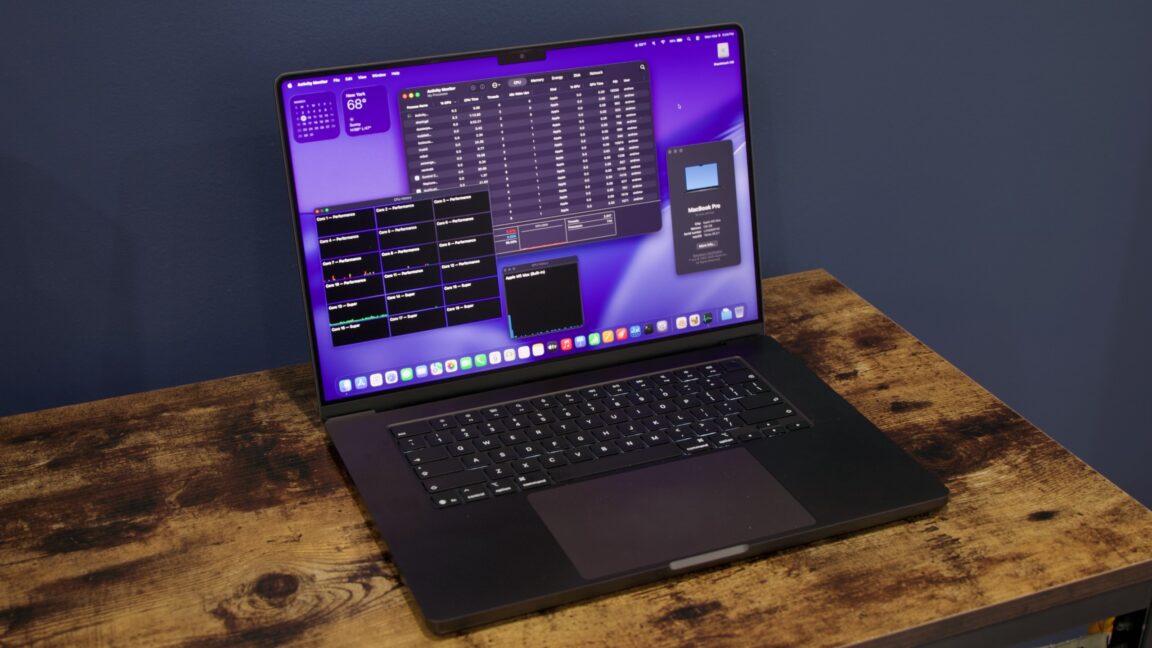
M5 Pro and Max unveiled

NotebookCheck's analysis of the M5 Max/Pro (also includes 15" M5 but not 13" for some reason):

M5 Max is doesn't do great here, but for some reason Apple shipped the 14" laptop with 128GB of RAM and it's clear the 14" model simply cannot cool the chip for sustained performance - so GB 6 shows really nice gains over the M4 Max, but CB R24 does not. Though efficiency improves a little. M5 Pro which has the same CPU is for some reason slower and less efficient than the M5 Max (though still an improvement over the top end M4 Pro as again now it has the same core count as the Max).
 
NotebookCheck's analysis of the M5 Max/Pro (also includes 15" M5 but not 13" for some reason):


M5 Max is doesn't do great here, but for some reason Apple shipped the 14" laptop with 128GB of RAM and it's clear the 14" model simply cannot cool the chip for sustained performance - so GB 6 shows really nice gains over the M4 Max, but CB R24 does notThough efficiency improves a little. M5 Pro which has the same CPU is for some reason slower and less efficient than the M5 Max (though still an improvement over the top end M4 Pro as again now it has the same core count as the Max).
I skimmed the article and find their conclusion perplexing. Doesn’t seem accurate to say it’s not faster. Also the claim that the X Elite has caught up but they haven’t tested it yet is a weird thing to say.
 
I skimmed the article and find their conclusion perplexing. Doesn’t seem accurate to say it’s not faster. Also the claim that the X Elite has caught up but they haven’t tested it yet is a weird thing to say.

The burst performance of the M5 Max is higher, but the M4 Max scores practically identically to the M5 Max in CB R24 indicating poor sustained performance. So for sustained loads, important for Max-level devices, it is not any faster. Hopefully this is just a 14” problem. However, again similarly the 18-core Pro which is the same CPU is not any faster in the 16”.

As for the X Elite, they may be going off of Qualcomm’s own benchmarks which naturally are suspect until actual devices are out.
 
I am noticing a lot of these reviews -- both written and video -- are poorly done, and they seem rushed. There are a slew of typos, mistakes, just weird shit. These are professionals, supposedly, and they've had time with the machines, yet can't manage to find errors in their own processes. For example, a popular YouTuber that benchmarks transformer models completely screwed up testing in the video because he didn't fully offload the model to the GPU....... which is like the entire point of the video. Then he literally asks "why is only part of the GPU performing?" Someone pointed this out in comments, but it's far from only this YouTuber, and a bunch of reviews I'm reading are just extremely poorly done. I put zero faith in most of these reviews, including ones with nonsensical conclusions. I'm very disappointed and irritated.
 
The burst performance of the M5 Max is higher, but the M4 Max scores practically identically to the M5 Max in CB R24 indicating poor sustained performance. So for sustained loads, important for Max-level devices, it is not any faster. Hopefully this is just a 14” problem. However, again similarly the 18-core Pro which is the same CPU is not any faster in the 16”.

As for the X Elite, they may be going off of Qualcomm’s own benchmarks which naturally are suspect until actual devices are out.
It seems there is an improvement on Cinebench 26 so perhaps it’s a matter of software optimization? 11% iirc. Also I am a little reluctant to draw too many conclusions from one render focused benchmark.
 
It seems there is an improvement on Cinebench 26 so perhaps it’s a matter of software optimization? 11% iirc.

Perhaps, if so it is more likely that Cinebench 26, which otherwise seems to favor older (and x86) CPUs, is responding to the 2 extra cores/threads better than Cinebench 24.

Also I am a little reluctant to draw too many conclusions from one render focused benchmark.

Of course one should never draw sweeping conclusions from a single benchmark, but that's still not a great result on a benchmark which Apple Silicon has typically performed very well on.

The burst performance of the M5 Max is higher, but the M4 Max scores practically identically to the M5 Max in CB R24 indicating poor sustained performance. So for sustained loads, important for Max-level devices, it is not any faster. Hopefully this is just a 14” problem. However, again similarly the 18-core Pro which is the same CPU is not any faster in the 16”.

As for the X Elite, they may be going off of Qualcomm’s own benchmarks which naturally are suspect until actual devices are out.

Actually it turns out Notebookcheck did test the Elite 2 themselves on a hands-on, however, it was a reference device, so again real world devices may behave differently.
 
Last edited:


This is an actually pretty well-produced video. The final test doing 3 things at once is enlightening. It's very amazing what M5 Max achieves. It's revolutionary
 
This score from the iphonedo review shows a 24% multicore increase in CB 26.
1773100258698.png
 
In the event you don't want to watch, which you absolutely should watch because it's one of the only coherent videos I've seen, he runs:

1. A 45 minute audio interview transcript with 5 tasks using 70 billion 6 bit transformer model
2. 1024 by 1024 pixel photo using a diffusion model
3. Rendering DaVinci Resolve 8K video with a 4K timeline

At the same time.

The highest end M3 using 80 cores and 512 GB of memory with 8TB of storage took 1-3 minutes longer across each task than the M5 Max did IN A NOTEBOOK on battery power, and it only drained 10% in that stress testing.

It's a true testament to Apple silicon! It's so amazing.
 
This score from the iphonedo review shows a 24% multicore increase in CB 26.
View attachment 38316
Apple gave him the 16" model - a pity he didn't run Cinebench 2024 as well ... and a pity Notebookcheck didn't run 2026 ... sigh it's so hard to figure out what is going on with incomplete data. I really wish I had the time and wherewithal to generate my own ...
 
Apple gave him the 16" model - a pity he didn't run Cinebench 2024 as well ... and a pity Notebookcheck didn't run 2026 ... sigh it's so hard to figure out what is going on with incomplete data. I really wish I had the time and wherewithal to generate my own ...
Yeah I guess I’m put off by the headline that the Max showed little improvement when what they mean is the 14” shows little improvement when compared to the 16” M4 Max
 
Yeah I guess I’m put off by the headline that the Max showed little improvement when what they mean is the 14” shows little improvement when compared to the 16” M4 Max
Fair, the one note of concern though is that the 16" Pro has the same CPU but with cut down memory bandwidth as the M5 Max and for some reason it's slower than the 14" M5 Max and is less efficient as well! Every previous time I've gone with the "it's the memory bandwidth" hypothesis to explain odd CB 24 results, I've usually, eventually, come to the conclusion that it wasn't. But here ... again, I don't know how else to explain this even though, as CPU bandwidth goes, the M5 Pro has a ton! (Not sure how much it can access admittedly) I mean, workstation CPU level bandwidth. So I dunno what's going on.

So it can't just be the 14"'s lack of cooling.
 
Notebookcheck has to look at their CP2077 1440P run again. There is no way the M5 Max is only 1fps faster than the M4 Max.
It could be throttling/overheating, but ... hmmmm ... the 1080p result is reasonable for that, the 1440p less so.
 
In the event you don't want to watch, which you absolutely should watch because it's one of the only coherent videos I've seen, he runs:

1. A 45 minute audio interview transcript with 5 tasks using 70 billion 6 bit transformer model
2. 1024 by 1024 pixel photo using a diffusion model
3. Rendering DaVinci Resolve 8K video with a 4K timeline

At the same time.

The highest end M3 using 80 cores and 512 GB of memory with 8TB of storage took 1-3 minutes longer across each task than the M5 Max did IN A NOTEBOOK on battery power, and it only drained 10% in that stress testing.

It's a true testament to Apple silicon! It's so amazing.
This is basically the tell that any reviews mentioning little improvement were likely done incorrectly.

There is obviously major improvements with the GPU on M5, but also the Media Engine received updates too (I've seen testing of the base M5).

Combine this with the Fusion Architecture and brand new Performance core paired with the world's fastest core (Super core), you're getting a machine that can smoke a desktop workstation class computer on battery power with ease, despite 4X less memory, 200 GB per s less bandwidth, 14 less CPU cores, and 40 less GPU cores.

Might want to think about how amazing that is lol.
 
Back
Top